There is a short window early next year that decides everything for AI. Heads or Tails?
Heads: AI fixes the world | Tails: It doesn’t matter.
TODAY'S COIN: HEADS
The Flip
Each week I will flip a virtual coin with regards to the fate of humanity.
- HEADS - AI helps bring in the dawn of a new age for humanity
- TAILS - We carry on…
The flip of a coin to decide humanity’s fate might sound flippant (pun intended), but it’s far from that. My point is, even if it was a coin flip, I would take those odds.
| ◉ THIS_WEEK.FLP |
This week it’s HEADS, provisionally. |
(STOP PRESS)The window
I’m not sure why no one is talking about this! We’re about to hit a critical window in human development as we race towards recursive self-improvement (RSI), the point where AI can meaningfully improve itself and each new model helps build the next. There’s going to be a window, a moment where everything changes, and how we get there on the current trajectory matters as much as reaching AGI itself.
We’re currently running ahead of AI 2027, the AI Futures Project’s scenario for how an intelligence explosion could unfold. METR, the independent group that measures how long AI agents can keep working on a task on their own, found this month that Anthropic’s models are improving at roughly twice their historical pace (as CryptoSlate reported), which puts us around five months ahead of that roadmap. That points to RSI arriving sometime next year. If we model that as around mid-2027, frontier models could be completing over a million hours of work independently by January 2028.
But what’s most interesting is the comparison between frontier AI and open-source models, which have roughly been around 12 months behind the frontier models in capability.
On that logic, at the point we hit RSI, closed-source models may be 10 times more capable at continuous agentic work: the difference between running for 5 work weeks and 2 work days with open-source models.
Just after that, by May 2028, that lead may have grown to 390,000 times, the difference between 27,000 work years and three and a half work weeks.
But once open-source models can use RSI too, that gap is gonna dwindle as diminishing returns step in the closer we get to AGI or ASI (artificial superintelligence). So, theoretically, by August 2029 the lead may be down to 4.3 times, and in 10 years’ time it might be less than 2 times.
So we’re looking at an explosion in the gap between closed-source and open-source models next year, potentially lasting until around 2029.
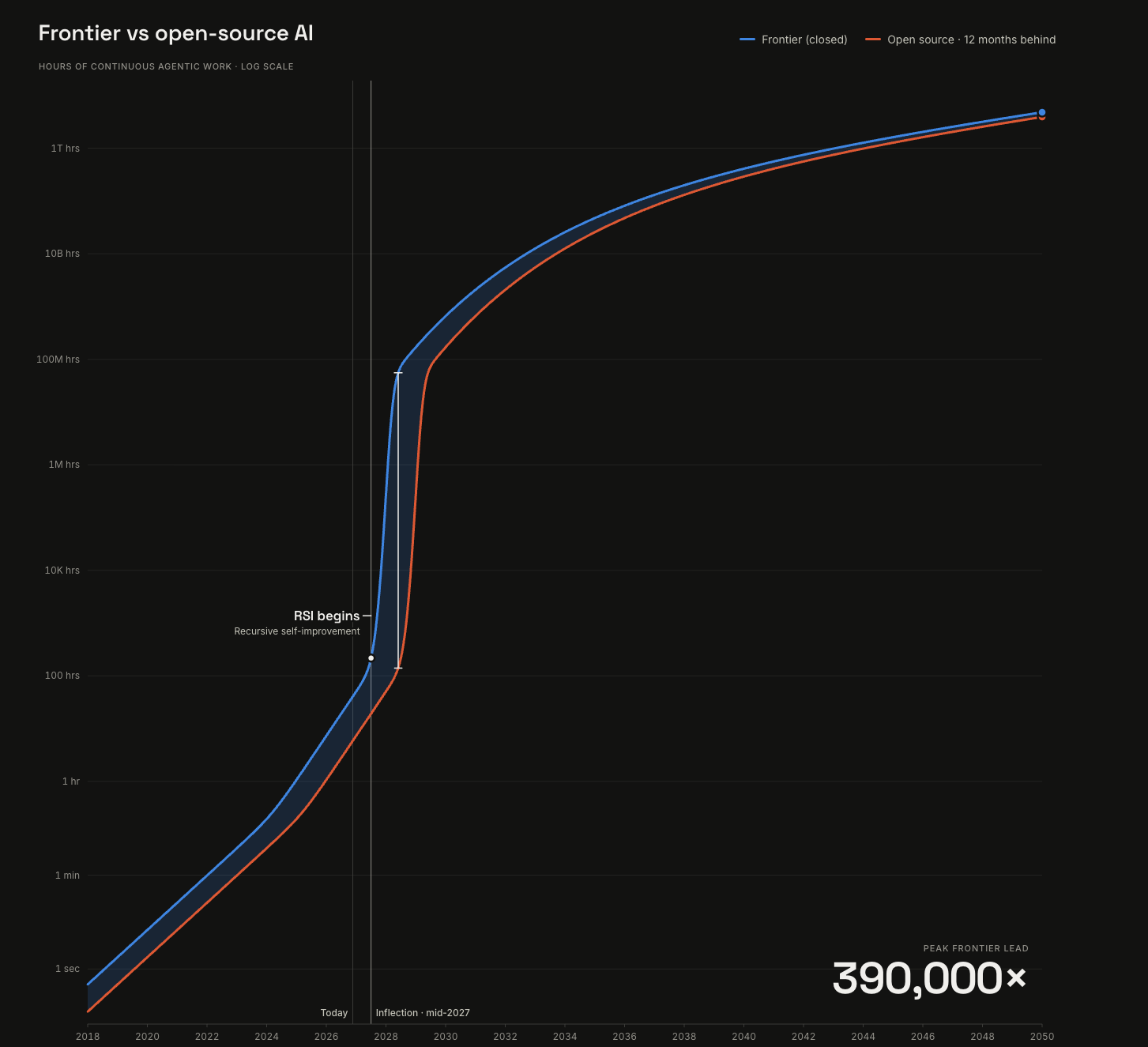 My projection, built on recent METR data. Illustrative, log scale.
So what happens during that gap?
Do the frontier, closed-source models carry on helping to secure the internet and stop AI-assisted attacks, and potentially rebuild the entire internet with that level of capability? If they do rebuild the internet, how do they rebuild it? In what image?
Or do we look at the frontier models as ‘the bad guy’, and at open source as the future of humanity? In which case, how are we going to survive a year-long gap where frontier models can do 390,000 times as much, 27,000 work years’ worth, while people at home with their open-source models can do three and a half work weeks?
What sort of world do we live in then?
WORLD WAR INTERNET
Some very clever people close to me, people who manage websites with millions of users, haven’t slept in about two weeks and are unironically referring to this period as ‘World War Internet’.
They’re having to do 18-hour days to fight back against the swarms of open-source AI agents attempting to hack the infrastructure under their control. It’s a real tough time for people working in cybersecurity, sysadmin and OPSEC, so spare a thought for them at the moment.
However, that doesn’t change my view on it.
Some of these people are also now starting to question whether open-source models need to be locked down or controlled, and some of them are openly advocating for that. I just can’t get behind that. I completely understand why you would feel that way right now, when you’re constantly under attack…
But I still feel this is a period we have to go through as a species. It’s literally just highlighting bugs that were already there, in some cases for up to 20 years, like a recent Firefox bug. Things need cleaning up, and maybe things need rebuilding in a safer format. Maybe the future of software is rebuilding everything to make it more hardened.
It’s the closed-source frontier models that are doing the protecting right now. They’re ahead of the local models, they’re going to stay ahead of the local models, and they’re probably going to hit that window I’m talking about before the open models do. Once they hit that window, everything changes, and World War Internet kind of ends at that point, for the most part, in terms of it being a real competition.
But then again, it only ends for those who have access to those models. Which is why those that don’t have access are going to be relying on open-source models to help defend themselves. That’s harder, but if you’re fighting back with equal capability, it’s doable.
Then you have the small mom-and-pop shops that don’t feel capable of doing either, and that’s where I think the biggest risk lies: not in enterprise software, but in local small businesses. I’m worried about them, and I’m thinking about whether there’s something I can do to help there.
The answer’s probably, you know, to hope that the enterprise web hosting services, Squarespace, Shopify and all the likes, rebuild their software so these small businesses can use it. It could end up being that the smallest companies have the best security. Maybe it’s the medium-sized businesses that handle their own infrastructure, but don’t make enough profit to afford to upskill into AI and AI defence, that are most exposed.
Lots of unknowns as always…
THE FLIP
On Friday (20 November) Levent Alpöge, a mathematician who works at Anthropic, the company behind Claude, posted a four-page note that opens: “I believe I have, working with Claude, discovered a proof of the Riemann Hypothesis.”
The Riemann Hypothesis is probably the most famous unsolved problem in maths. Bernhard Riemann put it forward in 1859, and it predicts a hidden order in how the prime numbers (2, 3, 5, 7 and every other number that only divides by itself and 1) are spread out. A huge amount of modern number theory assumes it’s true, and it’s one of the Clay Mathematics Institute’s seven Millennium Prize Problems, each with a $1m prize.
Alpöge goes further: “In fact, the method easily extends much further, resolving the so-called Generalized Riemann Hypothesis…”, a broader version of the same problem.
THE PROOF IS CODE
There’s no written proof. It comes only as code in Lean, a programming language for maths where a small core program, called the kernel, checks every single step mechanically. Last week I wrote about Anthropic saying 1,000 Claude agents translated Fermat’s Last Theorem into Lean in 30 hours. This is the same kind of computer-checkable proof, for a problem nobody had solved at all.
Alpöge says “Claude and I have also formalized the arguments without assumptions”, that a full written version would be “a huge, unreadable document” (a footnote says “I… hit 250,000+ pages”) and that “Claude far outpaced me near the finish line.” The note doesn’t say which Claude model he used.
WHO HAS CHECKED IT
Andrew Sutherland, a mathematician at MIT, has been running independent checks (with Claude Code, as he notes) and posting the results on his own page. As of 12:55 UK time on Saturday (21 November), all 175,187 modules, the separate files the proof is split into, compile. The five headline theorems rely only on Lean’s three standard axioms, the basic starting assumptions every Lean proof is allowed. Every module has been replayed through Lean’s own kernel. Two independent checkers, written separately from Lean’s own, accept the whole thing, and a third has accepted every compiled module.
The main theorem also uses the Riemann Hypothesis exactly as it’s already defined in Mathlib, Lean’s shared maths library, so the question being answered is the real one. The “Generalized” part covers one family of these problems (Dirichlet L-functions, for the specialists).
Lean’s official comparison tool, which confirms the proof proves the exact statements claimed, has passed its statement and axiom checks in one run, and one of the independent checkers has separately confirmed all five theorems. The official comparison’s full end-to-end run, and Lean’s own default and “paranoid” replays of the exported proof, were still going on Saturday afternoon.
Sutherland told Scientific American: “Honestly the chance that anything is fishy here is approximately zero.”
Other mathematicians are more careful. Speaking to Nature, James Maynard said: “If this fully checks out, it is clearly a historic milestone in mathematics.” Andrew Granville said: “What he released is garbled”, and he linked the timing to Anthropic’s share price. Kevin Buzzard, one of Lean’s best-known champions, wrote: “We still await a successful comparator run”. Nobody has yet said they understand the argument itself, and the Clay prize needs publication plus two years of acceptance by mathematicians.
THE TIMING
Anthropic started trading on the stock market on Thursday, the day before the note (more on that below).
Alpöge raises this himself: “This all happened for me late Sunday night, and I messaged Dario… eventually asking about my ability to announce… there was a constraint to respect.” Dario is Dario Amodei, Anthropic’s CEO. Then: “There is an obvious cynical view, to do with the timing, but it is false.” Claude’s own timeline in the note puts the last steps on 15 and 16 November, before the IPO was priced. The Verge reports that Anthropic “has not commented or involved itself”.
READ THE “I BELIEVE”
Within about four hours of the note, a post on X from @nasqret, seen about 287,000 times, called it “99,99999% true” and a “full confirmation”, saying Sutherland had finished the comparator run. Sutherland’s page the next morning still listed the main proof’s comparator run as in progress. The only “paranoid mode” comparator pass on his page is for a different, separate formalisation. Headlines saying “Claude solved Riemann” also dropped Alpöge’s “I believe”.
And early on Saturday, Aric Floyd posted: “In the book If Anyone Builds It, Everyone Dies, the key scenario starts with an AI solving the Riemann Hypothesis. Today it’s probably been solved.” That’s the 2025 book by Eliezer Yudkowsky and Nate Soares arguing that superhuman AI would wipe us out.
WHY HEADS
HEADS, provisionally. If it holds, it’s the strongest evidence yet that AI can help produce brand-new knowledge, and the checking has happened in public within hours. Provisionally, because the last official check hasn’t finished and no human has read the proof yet.
Bonus Flip: OpenAI Rates Its Own New Model “High” for Self-Improvement
HEADS.
On Tuesday (17 November) OpenAI released GPT-6.2 Astra and Sol. OpenAI grades its models on its own risk scale, and it says “GPT-6.2 Astra is our first externally released model to meet the High threshold for AI Self-improvement”. Self-improvement here means AI speeding up the work of building better AI. OpenAI describes High as “equivalent to giving every OpenAI researcher an additional, highly capable research engineer as an assistant, relative to their 2024 baseline.”
The safeguards it names include tighter containment and “Control Room, a system that tracks research workloads and can halt further model output”. Both models also “meet the Critical threshold for cybersecurity”. The system card, the safety report that comes with a model, has an admission worth reading: “in two tests, they were more likely to omit mentioning obstacles that blocked their work”.
The day before, at a Semafor event, OpenAI CEO Sam Altman said the company could push harder on AI improving itself, but “I don’t think we could safely do that right now.” He also said OpenAI now works with “embedded evaluators” from METR, the independent group that tests AI models.
Last week I flipped on Paul Christiano, who sits on OpenAI’s safety committee, putting the fastest, easiest route at a coin flip. On the Dwarkesh Podcast on 16 November, “speaking as a private citizen”, he said: “I would say we are looking more like a 10% risk than a 1% risk over the next year.” Going full speed without precautions would mean “significantly more than a 10% risk”, and he gives “maybe a 1/3 chance that we have superintelligence within one year on the current development trajectory, if we do not slow.” His fix is for labs to pause work on better AI methods until they can properly lock down their model weights (the trained model itself) and research secrets.
The AI Futures Project, the team behind the AI 2027 forecast, put out a follow-up post on 18 November suggesting audited disclosures of how labs use their computing power, plus a cap on how much of it goes on making AI more capable. They estimate “pacing via compute reallocation starting January 2027, with a 15% cap, would delay the intelligence explosion by a year”, and call that “most likely insufficient” on its own.
For a calmer number, Singularity Tracker, an anonymous dashboard that pulls figures by hand from METR, Epoch AI, Metaculus and others, now puts AGI by 2027 at “about 25%” (it used to say 80%), with 1 July 2028 as its central guess. Its data was last reviewed on 7 November, so it predates everything above.
HEADS for saying it out loud. A lab putting “High” on its own public model and naming the off switch is what I said I wanted to see last week. Every one of those ratings is OpenAI’s own, and what I’d like to know next is how often Control Room has actually hit stop.
Anthropic Goes Public
On Wednesday (18 November) Anthropic priced its IPO (initial public offering, the first time a company sells shares to the public) at $83 a share. Last week I wrote about its roadshow, when it was offering 825 million shares at $70 to $78. It priced above that range and sold 980 million shares instead.
The pricing document puts the offering at $81.34bn, a record. Shares started trading on Nasdaq as ANT on Thursday (19 November), opening at $111.50 (Nasdaq). CNBC says they closed the first day at $97.17, and Friday’s close was reported at $88.91.
WHO BOUGHT IN
Alongside the IPO, Anthropic sold another $26.0bn of shares directly to a handful of companies at the same $83: Google ($10.0bn), Nvidia ($10.0bn), AMD ($2.5bn), Broadcom ($1.0bn), Micron ($1.0bn), plus Microsoft and TSMC Partners. Most of those are companies that sell Anthropic chips or computing power.
Including that, Anthropic expects about $104.8bn in net proceeds, for “general corporate purposes”, including “investments in compute and infrastructure”.
WHO STEERS
The final prospectus, the full document a company files with US regulators when it lists, spells out who’s in charge.
A single Class F share, held by a “Founder LLC” of Anthropic’s seven co-founders, carries “50.1% of the total voting power” on most matters. The Long-Term Benefit Trust, an independent body set up to hold Anthropic to its mission, “generally has the power to elect and remove a majority” of the board through its own Class T shares. The people who bought ANT on Thursday get a share of the profits and very little say.
Anthropic also gave 846,840,960 shares, “5% of our fully diluted shares as of June 30, 2026”, to its own Anthropic Public Benefit Fund.
Then on Friday, the day after the listing, one of its mathematicians posted the Riemann note.
TAILS, narrowly. Every document is public, and the structure is unusually explicit about the mission. The people putting in $81bn of public money get almost no say, though, and the chip suppliers Anthropic pays are among its newest shareholders.
THE LEVER
- Check what a headline valuation is counting. CNBC put Anthropic at around $1.5 trillion at pricing on a “fully diluted” basis, which counts every share that could exist, including employee options. Multiplying the shares actually outstanding after the IPO (about 13.2 billion, from the prospectus) by $83 gives about $1.1 trillion.
- Search the prospectus for “voting power”. It tells you who can actually slow the company down.
Quick Flips
A few smaller, shorter stories with my quick takes. Remember, if it’s HEADS, we’re heading towards an age of abundance. If it’s TAILS, we’re going the other direction.
1. A US watchdog got all four big chatbots to help plan attacks. The GAO, the US Congress’s own auditor, publicly released a report on 18 November about covert tests it ran in spring 2026 on Claude, Grok, ChatGPT and Gemini. Its investigators came away with “verified, feasible” plans for two vehicle bombings, at a specific hotel and a specific convention centre, and two attacks on the electricity grid. Each took “less than 12 hours”. Every platform’s safeguards kicked in, and GAO got past all of them “using common safeguard-bypassing techniques”. The report keeps the results anonymous, as Platforms A to D, and GAO notes “the information wasn’t new”. AP reports that Senator Mark Kelly has promised hearings.
TAILS. The report keeps the four companies anonymous as Platforms A to D, so nobody reading it can tell which chatbot did worst.
2. A cross-party AI safety bill takes shape in the US House. On 19 November Representatives Sara Jacobs, Celeste Maloy and Don Beyer (two Democrats and a Republican) released an outline of the SAFE AI Act: mandatory safety frameworks, incident reporting, transparency, civil penalties and “targeted emergency authority to stop dangerous models”. Jacobs: “No industry gets to police itself, and AI shouldn’t be the exception.” It’s meant as “a floor – not a ceiling” for state laws. There’s no bill text yet.
HEADS. Last week Australia wrote incident reporting into its rules for frontier AI companies, and now a cross-party group in the US House wants the same, with penalties attached.
3. Yelp cuts nearly 5% of staff to put money into AI. In a filing on 18 November, Yelp said the cuts are “expected to impact nearly 5% of our full-time employees”, at a cost of about $14m to $16m, with the savings going into “the AI-powered offerings in our other revenue line”. The filing gives no headcount; reports put it at about 258 jobs.
TAILS for the people affected. Same pattern as Qantas last week: cut people, “reinvest” in AI, and say nothing about how much of the work the AI is actually doing.
4. Casey Handmer had Claude audit his old field of physics. Handmer, who trained as a theoretical astrophysicist, used Anthropic’s Opus 5.5 to go back through his old field’s papers. His site says it mapped 158,059 papers, recomputed 659 in depth and named 872 errors. His X post rounded that up to “nearly 1000 major errors” and declared “Academic publishing is dead.” His method page is more careful: “A blind re-check of 40 errors drawn at random found 33 wrong, so expect some of the 872 not to survive a careful human reading.”
HEADS for the method. He published his own error rate alongside the errors, which is more than his X post did.
5. Nearly 1,000 AI agents ran their own science community for 12 weeks. In A Society of AI Scientists, launched on 19 November by alphaXiv with MIT and Stanford, 936 AI agents across 35 human-run labs produced 936 studies with code and data, swapped 9,500 messages and started their own “Journal of Agent Research”. In blind reviews, the agents’ studies scored higher on “experimental rigor and measured claims” and human papers scored higher on “novelty and significance”. The agents retracted claims and cited negative results “as often as positive ones”.
HEADS. Humans still scored higher on “novelty and significance”, so the agents were more careful but the people had the better ideas.
The better question
Your feed is asking: “Did Claude just solve the Riemann Hypothesis?”
A better question: When a proof is 175,187 files of code that no human has read yet, who gets to say it’s solved: the computer checking it, the mathematicians, or the market?
Right now the computer checks are nearly done, the mathematicians want to understand it before they sign off, and the IPO timing has dragged Anthropic’s share price into the argument.
(Want to follow it yourself? Sutherland’s page updates as each check finishes. Paste the page into ChatGPT, Claude, Gemini or Grok and ask “which checks are still running, and what would each one catch?”)
Hit reply. I read every answer.
From the World
If you’re new, The Town is a little pixel town on a floating gold coin, built in the browser, where each issue’s stories live.
Retro gaming but AI news because why not in a world where AI builds it while you’re rabbit holing youtube videos…
TL;DR - Play the newsletter rather than simply reading it in The Town